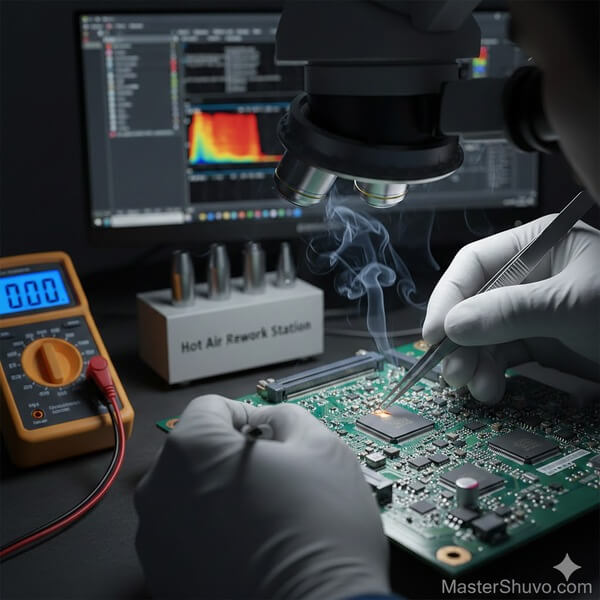
In today’s tech-driven world, your devices—be it a laptop, smartphone, or tablet—are more than just tools; they are essential to your daily life. But what happens when the motherboard fails? Instead of replacing the entire expensive board, there is a more surgical and cost-effective solution: Chip-Level Repairing.
If you are looking for expert electronics repair insights, MasterShuvo.com is your go-to destination. In this guide, we’ll dive deep into what chip-level repair is and why it’s the ultimate savior for your electronics.
What is Chip-Level Repairing?
Chip-level repairing refers to the process of diagnosing and fixing electronic devices at the component level. While “card-level” repair involves replacing an entire module (like a whole motherboard or a screen), chip-level repair focuses on identifying and replacing individual components on the circuit board, such as Integrated Circuits (ICs), transistors, capacitors, and resistors.
Think of it as surgery for electronics. Instead of buying a new car because the spark plug is broken, you simply replace the spark plug.
How Does Chip-Level Repair Work?
The process is highly technical and requires specialized tools and expertise. Here are the key stages:
1. Advanced Diagnosis
Technicians use tools like Digital Multimeters, Oscilloscopes, and Thermal Cameras to trace power rails and find “shorts” or “open circuits.” This involves reading complex motherboard schematics and boardview files.
2. Component Identification
Identifying whether the issue lies within a specific IC (like the Power Management IC – PMIC) or a Surface Mount Device (SMD) like a MOSFET is crucial.
3. Micro-Soldering
Since modern chips are incredibly small, technicians use Hot Air Rework Stations and high-precision soldering irons. This allows them to de-solder a faulty chip and replace it with a new one without damaging the surrounding board.
Why Choose Chip-Level Repair?
-
Cost-Effective: Replacing a single IC costs a fraction of what a new motherboard would.
-
Eco-Friendly: It reduces electronic waste by extending the life of your existing hardware.
-
Data Preservation: Repairing the original board often means you don’t lose your data, which is frequently tied to specific chips on the motherboard.
Common Devices That Need Chip-Level Repair
-
Laptops: Issues like “No Power,” “No Display,” or “Water Damage.”
-
Smartphones: Charging issues, touch screen failure, or network IC problems.
-
Gaming Consoles: GPU or HDMI controller issues.
Conclusion
Chip-level repairing is the pinnacle of electronic maintenance. It requires a blend of deep theoretical knowledge and manual precision. If your device has been declared “unfixable” by standard shops, it likely just needs a chip-level specialist.
For more technical guides and expert repair services, visit MasterShuvo.com.
